
PVC Resin
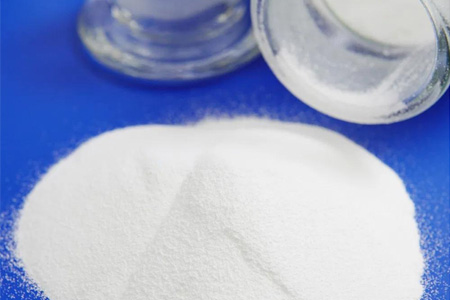
PVC Resin
Production
Polyvinyl chloride is produced by polymerization of the vinyl chloride monomer (VCM), as shown.
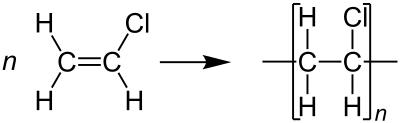
The polymerisation of vinyl chloride
About 80% of production involves suspension polymerization. Emulsion polymerization accounts for about 12%, and bulk polymerization accounts for 8%. Suspension polymerization affords particles with average diameters of 100–180 μm, whereas emulsion polymerization gives much smaller particles of average size around 0.2 μm. VCM and water are introduced into the reactor along with a polymerization initiator and other additives. The contents of the reaction vessel are pressurized and continually mixed to maintain the suspension and ensure a uniform particle size of the PVC resin. The reaction is exothermic and thus requires cooling. As the volume is reduced during the reaction (PVC is denser than VCM), water is continually added to the mixture to maintain the suspension.[9]
PVC may be manufactured from either naphtha or ethylene feedstock.
Microstructure
The polymers are linear and are strong. The monomers are mainly arranged head-to-tail, meaning that there are chlorides on alternating carbon centres. PVC has mainly an atactic stereochemistry, which means that the relative stereochemistry of the chloride centres are random. Some degree of syndiotacticity of the chain gives a few percent crystallinity that is influential on the properties of the material. About 57% of the mass of PVC is chlorine. The presence of chloride groups gives the polymer very different properties from the structurally related material polyethylene.[17] The density is also higher than for these structurally related plastics.[citation needed]
Producers
About half of the world's PVC production capacity is in China, despite the closure of many Chinese PVC plants due to issues complying with environmental regulations and poor capacities of scale. The largest single producer of PVC as of 2018 is Shin-Etsu Chemical of Japan, with a global share of around 30%.
2023-2-20 PVC--Applications
Pipes
Roughly half of the world's PVC resin manufactured annually is used for producing pipes for municipal and industrial applications. In the private homeowner market, it accounts for 66% of the household market in the US, and in household sanitary sewer pipe applications, it accounts for 75%. Buried PVC pipes in both water and sanitary sewer applications that are 100 mm (4 in) in diameter and larger are typically joined by means of a gasket-sealed joint. The most common type of gasket utilized in North America is a metal-reinforced elastomer, commonly referred to as a Rieber sealing system.
Electric cables
In a fire, PVC-coated wires can form hydrogen chloride fumes; the chlorine serves to scavenge free radicals and is the source of the material's fire retardancy. While hydrogen chloride fumes can also pose a health hazard in their own right, it dissolves in moisture and breaks down onto surfaces, particularly in areas where the air is cool enough to breathe, and is not available for inhalation.
Construction
"A modern Tudorbethan" house with uPVC gutters and downspouts, fascia, decorative imitation "half-timbering", windows, and doors
Unplasticised PVC (UPVC, almost synonymous with rigid PVC) is extensively used in the building industry as a low-maintenance material, particularly in Ireland, the United Kingdom, the United States, and Canada. In the US and Canada, it is known as vinyl or vinyl siding. The material comes in a range of colors and finishes, including a photo-effect wood finish, and is used as a substitute for painted wood, mostly for window frames and sills when installing insulated glazing in new buildings; or to replace older single-glazed windows, as it does not decompose and is weather-resistant. Other uses include fascia, and siding or weatherboarding. This material has almost entirely replaced the use of cast iron for plumbing and drainage, being used for waste pipes, drainpipes, gutters and downspouts. uPVC is known as having strong resistance against chemicals, sunlight, and oxidation from water
Signs
Polyvinyl chloride is formed in flat sheets in a variety of thicknesses and colors. As flat sheets, PVC is often expanded to create voids in the interior of the material, providing additional thickness without additional weight and minimal extra cost (see closed-cell PVC foamboard). Sheets are cut using saws and rotary cutting equipment. Plasticized PVC is also used to produce thin, colored, or clear, adhesive-backed films referred to simply as vinyl. These films are typically cut on a computer-controlled plotter (see vinyl cutter) or printed in a wide-format printer. These sheets and films are used to produce a wide variety of commercial signage products, including car body stripes and stickers.
Clothing
Black PVC trousers
Main article: PVC clothing
PVC fabric is water-resistant, used for its weather-resistant qualities in coats, skiing equipment, shoes, jackets, aprons, and patches.
The two main application areas for single-use medically approved PVC compounds are flexible containers and tubing: containers used for blood and blood components, for urine collection or for ostomy products and tubing used for blood taking and blood giving sets, catheters, heart-lung bypass sets, hemodialysis sets etc. In Europe the consumption of PVC for medical devices is approximately 85,000 tons each year. Almost one third of plastic-based medical devices are made from PVC.
Wire rope
PVC may be extruded under pressure to encase wire rope and aircraft cable used for general purpose applications. PVC coated wire rope is easier to handle, resists corrosion and abrasion, and may be color-coded for increased visibility. It is found in a variety of industries and environments both indoor and out.
Other uses
A vinyl record
PVC piping is cheaper than metals used in musical instrument making; it is therefore a common alternative when making instruments, often for leisure or for rarer instruments such as the contrabass flute. An instrument that is almost exclusively built from PVC tube is the thongophone, a percussion instrument that is played by slapping the open tubes with a flip-flop or similar.